

Ukrainian Youth Forum For Joint Action Event Report
Authors: Liliia Kurii, Laura Pistarini, Ludovica Romano
The Youth Forum for Joint Action, convened in Kyiv on November 23, 2023, underscored the indispensable role played by Ukrainian youth in responding to the full-scale invasion of February 2022 and mitigating its repercussions on the nation, showcasing their resilience and unwavering commitment in the face of adversity.
This forum provided a vital platform for Ukrainian youth to articulate their visions for the country’s future, addressing key priorities, needs, and challenges. Speakers representing diverse youth initiatives, movements, organizations, and networks shared valuable insights, fostering a constructive environment for dialogue with national and international partners and allies.
The primary aim of the event was to showcase the significant contributions of youth during the invasion and to forge connections with international stakeholders. By bringing together youth, experts, and practitioners, the conference shed light on existing capacities and provided a comprehensive overview of youth aspirations for Ukraine’s future.
The report represents the main findings and highlights of the forum, focusing on:
The importance of genuine empathy and a nuanced understanding of the agency of Ukrainian youth.
A call for international communities to listen attentively and stand in solidarity, recognizing the transformative power that extends beyond defined experiences.
Advocacy for fair funding practices and the dispelling of misconceptions about the role of young people in community-based efforts.

Kyiv Social Recovery Conference Event Report
Authors: Liliia Kurii, Laura Pistarini, Ludovica Romano
The Ukraine Social Recovery Conference, held in Kyiv on November 22, 2023, brought together a diverse range of stakeholders to address the profound impact of the Russian invasion and subsequent war. Throughout the conference, participants from local and national entities showcased remarkable resilience and unity in confronting the challenges posed by the conflict.
A key focus of the conference was on addressing the psychological support needs of affected populations, addressing disparities in resource allocation, and recognizing the pivotal role of communities, particularly those in post-war areas, in the process of social recovery.
The conference report encapsulates the multifaceted challenges identified during the event, spanning from issues such as ineffective leadership to communication barriers and the creation of unsustainable communities. It underscores the urgent need for comprehensive interventions, emphasizing the importance of effective communication, resource mobilization within the education sector, and the implementation of multi-level fundraising strategies. Additionally, fostering partnerships between communities and recognizing the necessity for additional financing are highlighted as critical components for sustaining and scaling up restoration initiatives.
The report emphasizes the significance of collaboration among government entities, non-governmental organizations, and the international community to facilitate a successful return to normalcy and to instill hope and stability for individuals rebuilding their lives in Ukraine.

Teachers in Romanian Secondary Schools: Challenges and Responses in Preventing Polarization and Extremism
Authors: Isabella Pirlogea, Dana Dolghin
This article discusses the main findings on the role of teachers and schools in preventing polarisation and extremism collected during the research undertaken in Romania within the framework of the H2020 project “PARTICIPATION”. The article analyses primary data collected through surveys, focus groups and interviews with primary and secondary school teachers on teaching complex issues in schools. It correlates the findings with research on the role of formal education in preventing polarisation and radicalisation. Specifically, it looks at the challenges faced by teachers when encountering contentious issues in classroom or school discussions and the ideation of their roles in these circumstances. The article concludes that, although there is an awareness of the role of teachers and the school environment in helping youth make sense of social and political issues which have competing and often sensitive interpretations and trigger fierce public debate, conceptions of the available resources and affordances of schools in these situations are limited and hindered by the system of formal education. Furthermore, interpretations of the needs of youth are systemically different between students and teachers. This leads to a decreased role of the traditional education system in responding to dynamics of polarisation and/or extremism among youth. Overall, it also weakens the role of formal education and schools’ role in preventing polarisation and extremism.

Authors: Isabella Pirlogea, Dana Dolghin
How to Explain Radicalization? A Comparison on the Driving Factors of the Far-Right, the Far-Left, Separatist and Religious Extremism is a book based on the research findings of a three year research program funded under the Research and Innovation Horizon2020 grants of the European Commission. Its main goal was to provide an updated, well-informed and nuanced picture of the contemporary factors influencing radicalisation pathways towards violent extremism and terrorism in the European landscape. Different kinds of extremism are taken into consideration (far-right, far-left, separatist and religious extremism) through a mixed research approach that combined a qualitative study with textual-statistical analyses. One of the most relevant outcomes of our research on current radicalization studies is that, for all types of extremisms analysed, the process of radicalisation is understood as an event that occurs at the intersection between a personal trajectory and a permissive, or enabling, environment. Cumulative extremism dynamics and new radicalising mediums and ‘host’ spaces are noted as further trends to be monitored. Our colleagues Isabella Pirlogea and Dana Dolghin have driven the research on the Far-Right Chapter, together with Kevin McDonald and Necla Acik from MiddleSex University, United Kingdom. They research and expertise led them to issues that include gamification, new technology and digital recruitment, social media tropes and mainstreaming of extremist content online, hate communities and youth radicalisation.
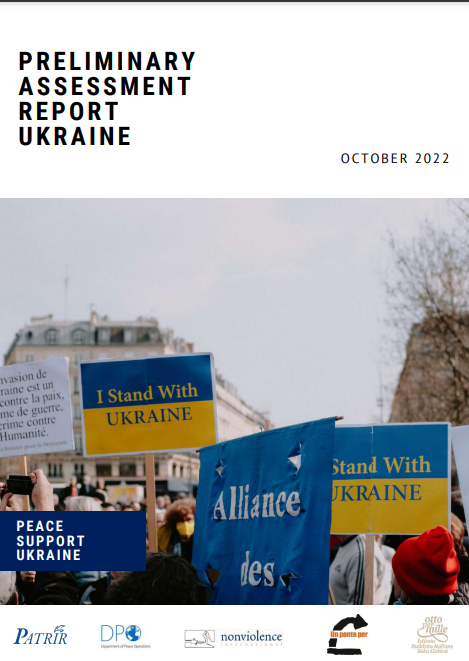
Ukraine Assessment Report (Preliminary)
Authors: Kai Brand-Jacobsen, Mariia Levchenko, Laura Pistarini Publisher: Department of Peace Operations (DPO) – PATRIR
This report has been prepared as part of the multi-phase assessment mission of the Peace Support Ukraine project by the Department of Peace Operations (DPO) of the Romanian Peace Institute (PATRIR) together with partners in Ukraine and in the diaspora. Although the full assessment will analyze the period between July 2022 and November 2022, this document shares preliminary findings to inform further strategic analysis of the developing situation on the ground and concrete actions to strengthen the international response to sustaining efforts by Ukrainian civil society, state and nonstate actors, while ensuring comprehensive inclusion of Ukrainian voices. It represents the first part of a two-stage review of the needs, challenges, opportunities and critical areas of action identified by Ukrainian civil society organizations, experts, local authorities and national government institutions addressing the impact of the invasion and war on the people of Ukraine. As well as identifying key priorities for peacebuilding and addressing the impact of the armed conflict, invasion and temporary occupation of Ukrainian territories now, during the war, the report also identifies key measures needed to prepare now to be able to address critical needs for peacebuilding, stabilization and post-war recovery and peace consolidation after the ending of the war.

Active European Citizens Against Hate Speech
Hate, Euroscepticism, Citizenship: The Youth Connection
Comparative Report
The research objectives focus on the analysis of hate discourses and practices in terms of definitions, European and national standards, targets, actors, anti-discrimination policies, and good practices. It studies the emergence and manifestations of Euroscepticism in countries with predominantly Eurooptimistic and Eurorealistic sentiments. The study also examines civic activism as a key factor in countering hate discourses and practices and in promoting the European values of respect for difference, liberty, equality, and human dignity.
Download the Comparative Report

Cluj Collaborates or Colaborarea Clujeană is a magazine by, about and for Cluj. It was created to make visible the amazing work that is being done by organisations, institutions and individuals across the community, and to celebrate and inspire creativity, collaboration, and practical engagements to make a difference in the lives of Clujeni.
The regular edition is more complex and has more articles (here you can explore the previous one), but given the current humanitarian crisis, our team was fully involved in the humanitarian aid offered to refugees from Ukraine and within Ukraine. Back in January 2022, we had three interviews with three amazing women and the incredible work they have been doing within their organizations/projects. We did not want to let these interviews to waste, thus we issued this special edition focusing solely on these three conversations.
If you wish for your initiatives, events, projects or publications to be featured in the next edition send us an email at [email protected]

Cluj Collaborates or Colaborarea Clujeană is a magazine by, about and for Cluj. It was created to make visible the amazing work that is being done by organisations, institutions and individuals across the community, and to celebrate and inspire creativity, collaboration, and practical engagements to make a difference in the lives of Clujeni.
Cluj Collaborates is a magazine for all the people of Cluj. We hope to make us all: aware of the exciting, very often inspiring, and great work being done by so many different people and sectors in Cluj; identify issues and challenges which are important to us to address to improve quality of life and wellbeing of the people of Cluj; create connections and inspire collaboration, solutions-oriented approaches, and future initiatives, doing more together than can be done apart.
Collaboration is in the name in and everything that Cluj Collaborates is about. Collaboration within and across sectors, institutions, and our community as a whole.
Cluj Collaborates was born from the Cluj Roundtables organized by the Romanian Peace Institute – PATRIR in cooperation with the Cluj City Hall and bringing together public institutions, local government authorities, NGOs, civic and cultural institutions, universities, schools, companies and more.
Today, Cluj Collaborates is published in Romanian and English. We hope with our next edition to be in Hungarian as well. The publication is free and distributed online.
We want to thank all partners who have contributed to this edition! If you wish for your initiatives, events, projects or publications to be featured in the next edition send us an email at [email protected]

The polarisation of society has now become a buzzword that is hardly missing from any political analysis. Trump, the Brexit, migration and the flight movement from the South to Europe, which has almost been pushed into the background again, also globalisation and climate change, and the Corona pandemic, which has been going on for a year now … In all these topic areas, a very fundamental polarisation of positionings is indeed emerging, which overshadows intermediate tones.
The focus of the issue on “Polarisation, Radicalisation and Discrimination in Europe” focuses in particular on the situation in Central and Eastern Europe in the practice of prevention and intervention in the field of democracy education, group-focused enmity and right-wing extremism. Contributors to this issue include those who have been working on-the-ground in the countries, as members of civil society organisations with a sharp and trained eye; those who work in municipalities, schools and extracurricular education as “fighters on the front line” (first-line practitioners, FLPs for short, e.g. teachers, social workers, NGOs, police) on a daily basis in regular structures, in training courses, and workshops as well as in counselling; and have in-depth insights and experience of the challenges, barriers and attempts at solutions.
The articles were written for the German journal Demokratie gegen Menschenfeindlichkeit.
This special issue has been produced within the Champions Project.

Editors
Cluj Collaboration Editorial Team
Project
Cluj Roundtables – CHAMPIONs
Each month, “Cluj Collaboration” shares news about events in Cluj, Europe and around the world of interest, as well as updates on upcoming Cluj roundtables, their reports, and news about courses and conferences. The fifth edition is now available online.
- Publisher
PATRIR - Location
Cluj-Napoca, Romania - Year
May 2021 - Download PDF
Romanian

Editors
Cluj Collaboration Editorial Team
Project
Cluj Roundtables – CHAMPIONs
Each month, “Cluj Collaboration” shares news about events in Cluj, Europe and around the world of interest, as well as updates on upcoming Cluj roundtables, their reports, and news about courses and conferences. This is the fourth edition of the monthly magazine.
- Publisher
PATRIR - Location
Cluj-Napoca, Romania - Year
March 2021 - Download PDF
Romanian

Editors
Florina-Marieta Neagu
Project
Cluj Roundtables – CHAMPIONs
Each month, “Cluj Collaboration” shares news about events in Cluj, Europe and around the world of interest, as well as updates on upcoming Cluj roundtables, their reports, and news about courses and conferences. This is the third edition of the monthly magazine.
- Publisher
PATRIR - Location
Cluj-Napoca, Romania - Year
February 2021 - Download PDF
Romanian

Editors
Florina-Marieta Neagu
Project
Cluj Roundtables – CHAMPIONs
Each month, “Cluj Collaboration” shares news about events in Cluj, Europe and around the world of interest, as well as updates on upcoming Cluj roundtables, their reports, and news about courses and conferences. This is the second edition of the monthly magazine.
- Publisher
PATRIR - Location
Cluj-Napoca, Romania - Year
January 2021 - Download PDF
Romanian

Editors
Florina-Marieta Neagu
Project
Cluj Roundtables – CHAMPIONs
Each month, “Cluj Collaboration” shares news about events in Cluj, Europe and around the world of interest, as well as updates on upcoming Cluj roundtables, their reports, and news about courses and conferences. This is the first edition of the monthly magazine.
- Publisher
PATRIR - Location
Cluj-Napoca, Romania - Year
December 2020 - Download PDF
Romanian

As part of the project TAKEDOWN, our colleagues from FUNDEA have developed a European Baseline Report on organised crime and terrorism intended to set analytical fundamentals for the project. The report highlights the explanatory power and the deficits of existing models to tackle organised crime and terrorism, whilst comparing different approaches, strategies and policies related to these phenomena.
We in PATRIR as members of the TAKEDOWN consortium have been very active in this process, giving input and expertise when needed to. We appreciate and salut the efforts of FUNDEA and all the partners who collaborated in this report to shed some light on the European and international OC/TN landscape in terms of stakeholders, representatives, responses and solutions. From PATRIR, we consider this work crucial in terms of moving towards evidence-based policy making and programming.
More information
Project page

Our colleagues and friends from United Network of Young Peacebuilders, ASHA Centre, European Intercultural Forum e.V., Humana People to People in Latvia and Habitat have developed a manual intended to provide a springboard for educators, learners and organisations to create further educational programmes and partnerships to promote Peace Education.
We as PATRIR have enjoyed being part of the process, giving input and expertise and we welcome and salute their efforts to mainstream peace education, to which PATRIR is dedicated as well.
More information
Project site
Download PDF
Engish

Editors
Denis Matveev, Galina Shelari, Elena Bobkova, Bianca Cseke
Project
Making Visible the Economic and Social Costs of Frozen Conflict and Benefits of Peace – Moldova-Transdniestria (IMPACT)
Funders
Global Conflict Prevention Pool, British Embassy in Moldova